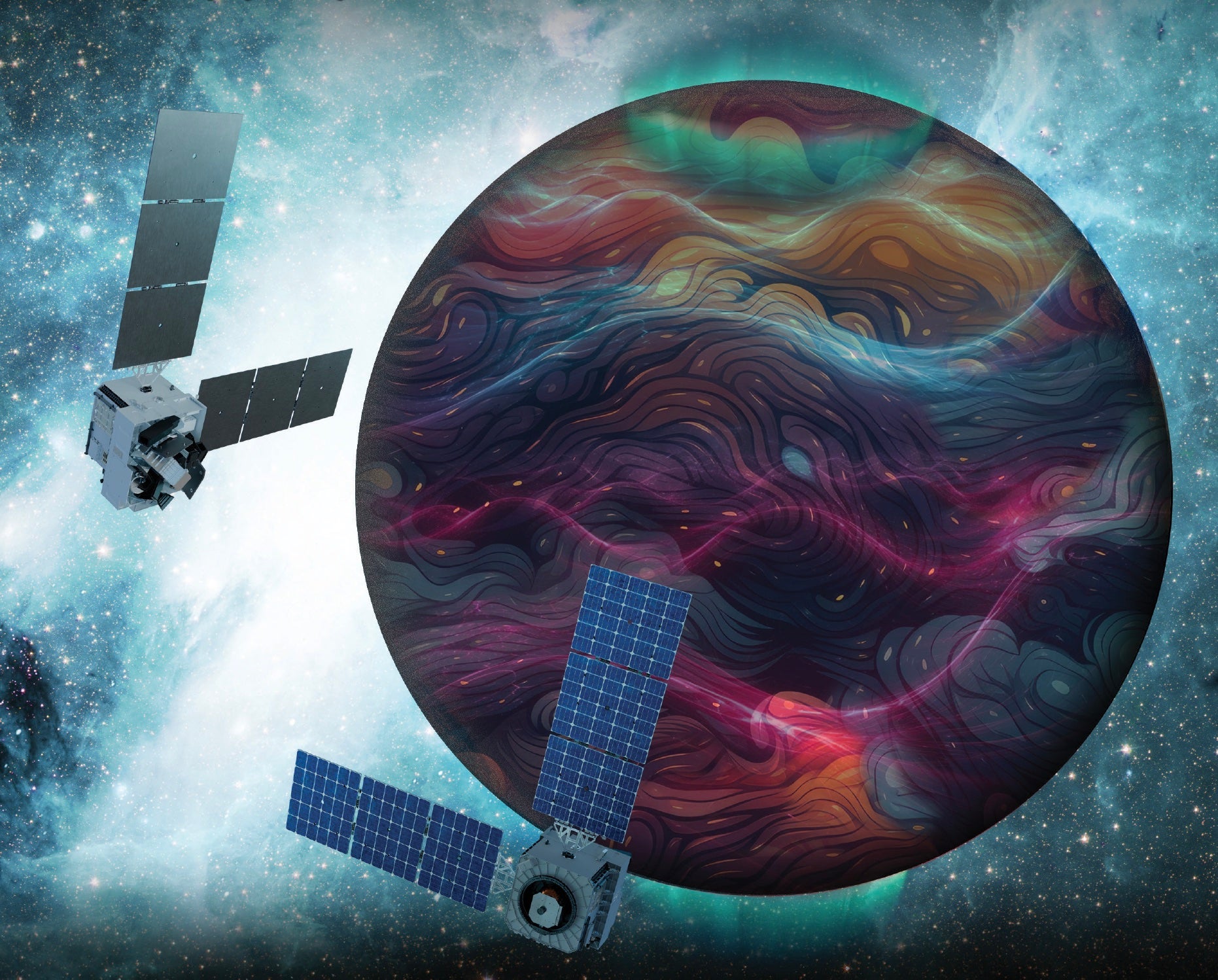
NASA Greenlights DAPHNE: Twin Satellites to Map Where Earth's Weather Meets Space
NASA has selected a new mission concept called DAPHNE to study the complex interaction between Earth's atmosphere and space weather. The mission will use two identical satellites to investigate how changes in Earth's lower atmosphere influence space weather in the upper atmosphere, aiming to improve predictions for GPS systems, low-Earth orbit satellites, and astronaut safety.
What Is Space Weather
Space weather refers to the effects of solar activity on the space environment around Earth. The Sun continuously emits a stream of charged particles known as the solar wind. When the solar wind interacts with Earth's magnetic field and atmosphere, it triggers phenomena including auroras, geomagnetic storms, and ionospheric disturbances.
These phenomena may seem distant, but they directly affect daily life. Intense space weather events can disrupt GPS signals, causing navigation errors. They can damage electronics on low-Earth orbit satellites. They can even pose radiation risks to astronauts aboard the International Space Station. In February 2022, a geomagnetic storm caused atmospheric expansion and increased drag, resulting in the loss of 40 SpaceX Starlink satellites in a single event.
DAPHNE's Core Objective
DAPHNE stands for Dynamic Atmosphere-Ionosphere Explorer. Its primary goal is to answer a question that has long puzzled scientists: how do changes in Earth's lower atmosphere propagate upward to form space weather in the upper atmosphere?
Earth's atmosphere extends from the surface to hundreds of kilometers above. Different layers have vastly different characteristics. In the thermosphere, roughly 80 to 500 kilometers altitude, the neutral atmosphere gradually transitions into ionized plasma. This is where space weather primarily occurs. Scientists have known that meteorological phenomena in the lower atmosphere—storms, atmospheric waves, and other disturbances—can travel upward and affect the thermosphere. But the specific mechanisms and processes remain poorly understood.
DAPHNE will address this gap through two identical satellites performing the first coordinated, multi-point measurements of neutral winds, temperature, and composition in the thermosphere. This approach will help scientists distinguish between different sources of influence and build more accurate predictive models.
Mission Design and Technical Features
DAPHNE's design reflects a "low-risk, high-reward" philosophy. The two satellites will carry identical instrument suites but operate in different orbits, enabling simultaneous observations of the same region at different altitudes or different longitudes.
The mission's primary measurement targets include:
- Neutral wind speed and direction in the thermosphere
- Temperature distribution in the thermosphere
- Atmospheric composition changes
- Energy exchange between the ionosphere and thermosphere
These data will be combined with ground-based observations and other satellite measurements to construct a complete energy transfer chain from the lower atmosphere to the thermosphere.
Timeline and Budget
DAPHNE has entered Phase B development, which includes spacecraft design and mission operations planning. The mission will undergo a confirmation review in 2027 to assess progress and funding availability.
If confirmed, the total mission cost, excluding launch, will not exceed $250 million in fiscal year 2023 dollars. The planned launch date is no earlier than 2029.
Scientific Significance and Applications
DAPHNE's scientific significance lies in its systematic investigation of the coupling mechanism between the lower and upper atmosphere. This research will not only advance understanding of Earth's atmospheric system as a whole, but also provide critical physical foundations for space weather forecasting.
In practical terms, DAPHNE's data will directly serve:
- Improved accuracy for GPS and other satellite navigation systems
- Better orbit prediction and lifespan assessment for low-Earth orbit satellites
- Radiation protection planning for crewed space missions
- Vulnerability assessment of ground communication systems during space weather events
As human space activities increase and dependence on technologies like GPS deepens, accurate space weather forecasting becomes increasingly important. DAPHNE will lay the groundwork for a more comprehensive space weather prediction system.
Mission Background
DAPHNE was proposed in response to NASA's DYNAMIC (Dynamical Neutral Atmosphere-Ionosphere Coupling) mission announcement of opportunity. The mission is led by Aimee Merkel from the Laboratory for Atmospheric and Space Physics at the University of Colorado, Boulder. Funding and management oversight are provided by the Solar Terrestrial Probes program at NASA's Goddard Space Flight Center in Greenbelt, Maryland.
Source: NASA Published: June 18, 2026 Original URL: https://www.nasa.gov/news-release/nasa-mission-to-study-space-weather-impacts-of-earths-atmosphere