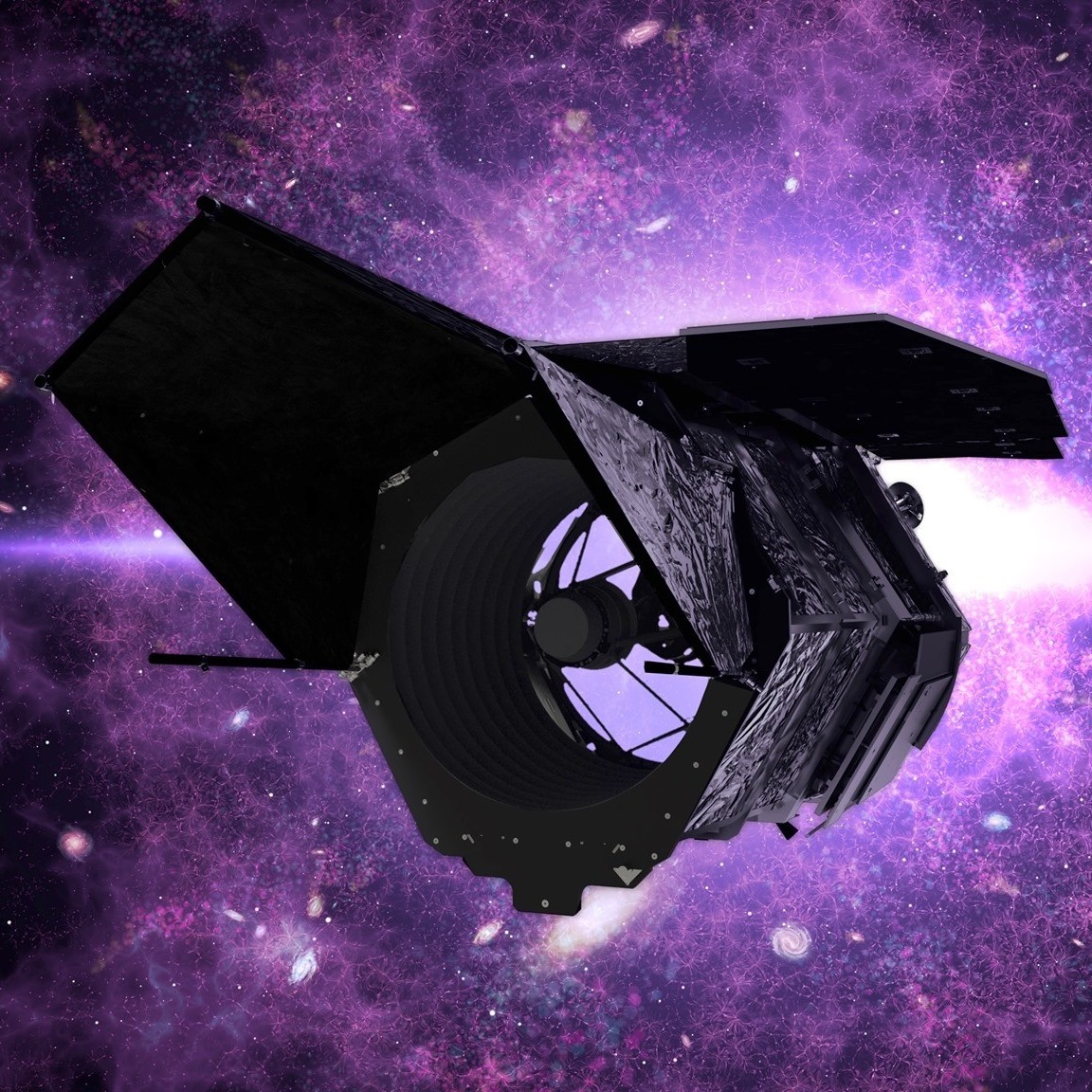
When we look up at the starry sky, we can't help but wonder: Where is the end of the universe? Are there other habitable planets besides Earth? How exactly does dark energy drive the continuous expansion of the universe? These cosmic mysteries that have puzzled humanity for years may soon have new answers—because NASA's next-generation space observatory, the Nancy Grace Roman Space Telescope (NASARoman), is ready to launch as early as the fall of 2026, embarking on an unprecedented journey of cosmic exploration.
Let's officially introduce this "new protagonist of cosmic exploration" to everyone: The Roman Telescope is named after Nancy Grace Roman, NASA's first chief astronomer. Known as the "Mother of Space Astronomy," this scientist laid a solid foundation for NASA's space observation career. Naming this telescope after her is not only a tribute but also an inheritance—inheriting humanity's endless curiosity and desire to explore the universe.
When it comes to space telescopes, most people will probably think of the Hubble Space Telescope first. After all, this "old friend" that has been in service for 35 years has taken countless stunning cosmic images, allowing humans to see the appearance of distant galaxies clearly for the first time. But the Roman Telescope is not simply a "Hubble upgrade"; it is a brand-new observation tool with "precise positioning and complementary advantages"—its field of view is at least 100 times that of Hubble!
Some friends may not have an intuitive understanding of "field of view." Simply put, the sky area that Hubble can observe at one time is like taking a macro photo of a flower with a mobile phone—you can see the details of the petals, but not the entire plant; while the Roman Telescope is equivalent to taking photos with a wide-angle lens, capturing the scene of the entire garden at one time. What's even more amazing is that thanks to its larger field of view, its survey speed is 1000 times faster than Hubble, which means that in the same time, Roman can observe more galaxies, more celestial bodies, and collect a huge amount of cosmic data.
In addition to "seeing wider and faster," the "hardware configuration" of the Roman Telescope is also impressive. It has a 2.4-meter diameter primary mirror, the same as Hubble's, but it is lighter and more exquisitely designed, allowing it to conduct observations in a more stable orbit—it will operate at the Sun-Earth L2 Lagrange point, which is far away from Earth's light pollution and atmospheric interference, providing a purer cosmic view for observations. Its design life is as long as 5 years, with a goal of serving for 10 years, continuously delivering "first-hand information" of the universe to humanity.
As a flagship infrared space telescope, the Roman Telescope is equipped with two core scientific instruments, each with a clear division of labor and performing their respective duties. The first is the Wide Field Instrument (WFI), a 340-megapixel infrared camera that covers the visible to near-infrared bands. It can image a large area of the sky at one time, mainly used to measure dark energy, carry out galaxy surveys, observe supernovae, and map the distribution of cosmic matter through weak gravitational lensing technology, helping scientists solve the mystery of cosmic expansion.
The second instrument is the Coronagraph (CGI), a technology demonstration instrument whose core function is to "block starlight"—as we all know, the brightness of a star is far greater than that of the planets orbiting it, just like looking for a small firefly next to a high-power light bulb, which is almost impossible. The coronagraph can act like a "light shield," blocking the strong light of the star, allowing us to directly observe the exoplanets orbiting it, and even see the appearance of protoplanetary disks, providing key data for the future search for habitable planets and the study of planet formation and evolution.
Speaking of which, some friends may ask: What exactly is the Roman Telescope going to do in space? In fact, its core scientific goals are to solve the four major cosmic problems that humans care about most. First, to solve the mystery of dark energy, the most mysterious force in the universe that drives the accelerated expansion of the universe. Roman will accurately measure the expansion speed of the universe through three different methods and test the correctness of general relativity; second, to conduct an exoplanet census, using gravitational microlensing technology to discover thousands of exoplanets, including possibly Earth-like planets; third, to study cosmic structure and evolution, map 3D maps of billions of galaxies, and explore galaxy formation, dark matter distribution, and the structure of the Milky Way; finally, the Roman Telescope adheres to the concept of "open science," opening about 25% of its observation time to astronomers around the world, and making all observation data 100% public, allowing scientists around the world to participate in cosmic exploration.
According to the plan, the Roman Telescope will be launched by a Falcon Heavy rocket from NASA's Kennedy Space Center, with the earliest departure in the fall of 2026 and no later than May 2027. Its arrival will fill the gap of the Hubble Space Telescope in wide-field surveys, complement the James Webb Space Telescope, and jointly build NASA's "space observation matrix."
From Hubble to Webb, and then to the upcoming Roman, humanity's pace of exploring the universe has never stopped. Every space telescope is an "eye" extended by humans to the universe. They carry our curiosity and yearning, fly to farther deep space, and uncover one cosmic mystery after another.
In 2026, let's look forward to the launch of the Roman Telescope, look forward to it bringing us a new perspective of the universe, and look forward to humanity taking a more solid step on the road of exploring the universe. After all, the universe is so big, we always need to see more.