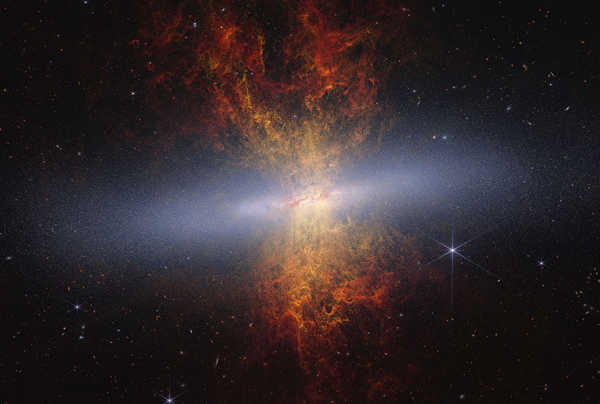
Webb Telescope Pierces Through Dust to Reveal 16.5 Million Stars in the Cigar Galaxy
The James Webb Space Telescope (JWST) has captured a near-infrared view of the nearby starburst galaxy Messier 82 (M82), revealing approximately 16.5 million individual stars and the galaxy's distended disc structure for the first time. Combined with archival visible-light data from the Hubble Space Telescope, the composite image was released by NASA on June 23.
A Galaxy on Fire
Located about 12 million light-years away in the constellation Ursa Major, M82 is nicknamed the Cigar Galaxy for its elongated appearance when viewed edge-on. It is classified as a starburst galaxy, forming stars at a rate roughly ten times that of the Milky Way.
This intense star formation comes at a cost. Powerful outflows of material are being ejected from above and below the galactic disc, creating bipolar plumes of ionized gas. In Hubble's visible-light imagery, these appear as yellow tendrils of ionized hydrogen. Farther from the disc, Webb's infrared data reveals red-orange material composed of small dust grains known as polycyclic aromatic hydrocarbons (PAHs), which help trace the distribution of the interstellar medium.
Seeing Through the Dust
Because M82 is oriented edge-on relative to Earth, its central disc is heavily obscured by dust, making it difficult to study in visible light. Webb's Near-Infrared Camera (NIRCam) can penetrate these dust layers, allowing astronomers to observe the stellar population within the galactic disc directly.
The luminous blue granules visible in the image represent only a fraction of the stars astronomers believe reside in M82. The actual stellar population is expected to be significantly larger.
Why It Matters
Webb's detailed observation of M82's disc plane is helping astronomers reconstruct the galaxy's formation history. By analyzing stellar distribution and gas dynamics, scientists can better understand the physical processes occurring within starburst galaxies — and how these processes eventually lead to the cessation of star formation.
"Extreme star formation will eventually deplete or expel the gas in the galaxy, bringing star birth to an end," NASA explained in its press release.
Further Reading
Source: https://science.nasa.gov/asset/webb/m82-cigar-galaxy-webb-hubble/