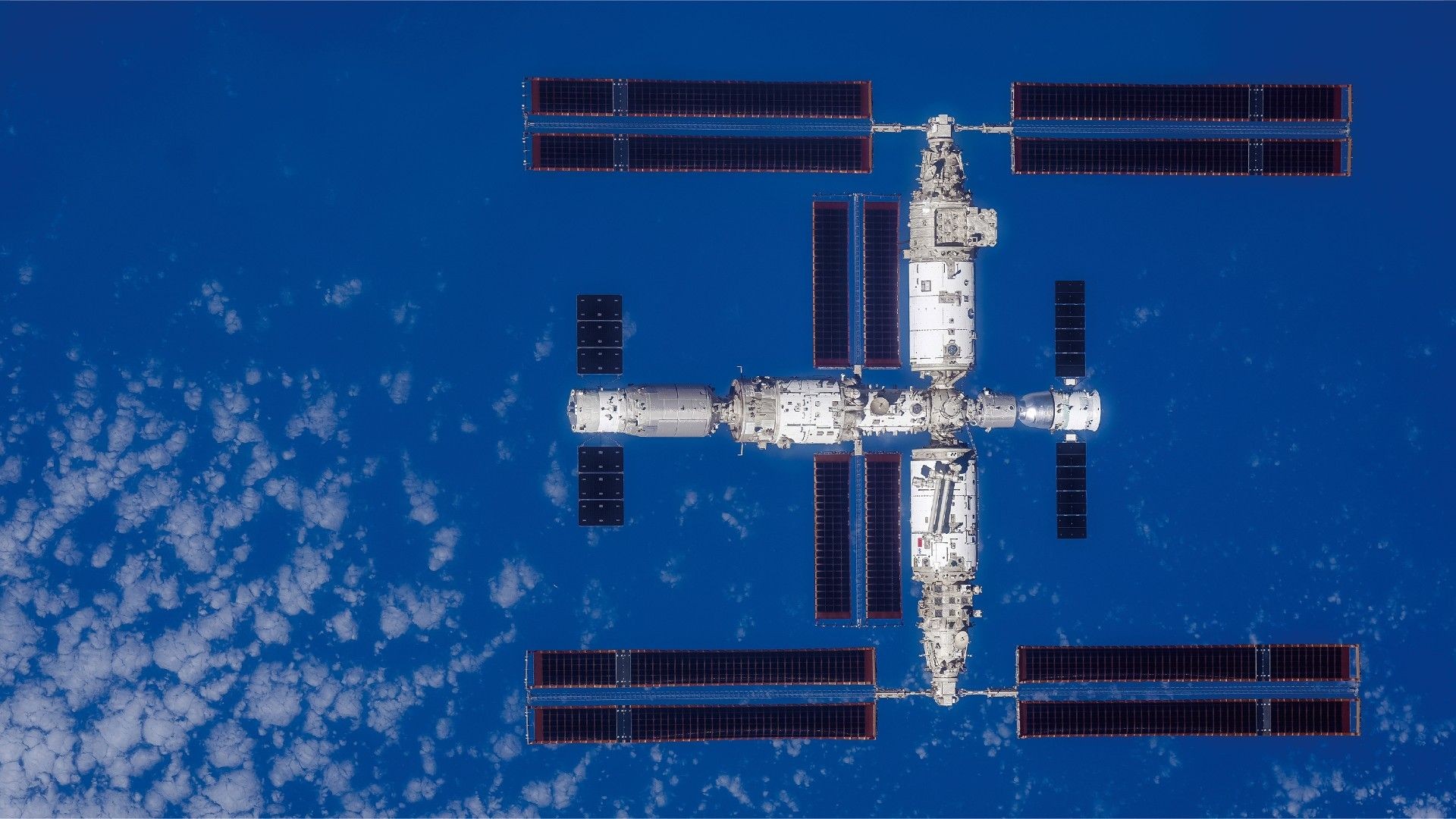
China Plans to Double Tiangong Space Station, With Hubble-Class Telescope Launching First
China plans to expand its Tiangong space station from three to six modules in the coming years and add a co-orbiting space observatory comparable to the Hubble Space Telescope. The expansion comes as the International Space Station approaches the end of its operational life.
The T-shaped Tiangong station was assembled in orbit between 2021 and 2022, comprising the Tianhe core module and the Wentian and Mengtian laboratory modules, with a total mass of about 90 metric tons. Qian Hang, a researcher with the China Aerospace Science and Technology Corporation (CASC), told Chinese media that the expansion has always been part of the original plan.
From T-Shape to Double-T
The expansion will add a 20-ton-class multifunctional module and two new experiment modules, transforming the station's configuration from a T-shape to a double-T. The new modules will provide additional docking ports, allowing more spacecraft to berth simultaneously.
Qian explained that as mission density increases, the current docking ports risk "queuing" delays and lack sufficient emergency buffer capacity. The multifunctional module will be the first to launch, docking with the Tianhe core module.
Once complete, Tiangong's total mass will grow from 90 to 180 metric tons.
Xuntian Telescope: Arriving in 2027
Before the new modules arrive, Tiangong's first addition will be the Xuntian space telescope. With a 2-meter primary mirror — slightly smaller than Hubble's — Xuntian boasts a field of view roughly 300 times larger.
Scheduled for launch in 2027, Xuntian will carry a 2.5-billion-pixel camera and is expected to survey approximately 40% of the sky during its planned 10-year operational lifetime. The telescope will share a similar orbit with Tiangong, allowing it to dock with the station for maintenance, refueling, repairs, and potential upgrades.
Overlapping Timelines with ISS Retirement
China's expansion plans come as the International Space Station nears its end. NASA plans to launch the SpaceX-developed U.S. Deorbit Vehicle in the coming years to guide the ISS into a controlled reentry over the Pacific Ocean, currently targeted for late 2030 or early 2031.
While the U.S. is developing several commercial station concepts to succeed the ISS, China's expanded Tiangong would become the largest — and potentially the only — permanent crewed outpost in orbit.