SLS Block 1
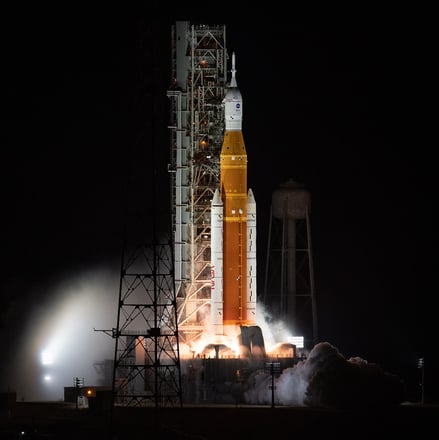
The Space Launch System (SLS) is a heavy-lift launch vehicle developed by NASA since 2011, based on space shuttle technology. It is designed to replace the retired U.S. Space Shuttle and serve as the primary launch vehicle for NASA’s deep space exploration programs. Its technology is derived from the canceled Ares V rocket (which originated from the Space Shuttle Program and was scrapped along with the Constellation Program), and its core purpose is to carry the Orion spacecraft for the Artemis Program, launching from Launch Complex 39B (LC-39B) at NASA’s Kennedy Space Center in Florida.
The SLS is being developed in three main phases: Block 1, Block 1B, and Block 2, with increasing payload capacity. Block 1 will launch the first three Artemis missions, followed by Block 1B for the next five missions, and Block 2 for all subsequent flights. Authorized for its first launch by the U.S. Congress in December 2016, the SLS was delayed at least 16 times and finally made its maiden flight in November 2022, more than five years later than the original six-year plan.
After its maiden flight, it briefly became the most powerful launch vehicle in the world by lift-off thrust, a record that was broken by SpaceX Starship five months later. According to plans, after the first four Artemis missions, the production and launch of the SLS will be transferred to Deep Space Transport LLC, a joint venture between Boeing and Northrop Grumman. Additionally, the Artemis Program will use the SLS at most once a year until at least 2030. The SLS also lays the foundation for potential crewed Mars missions.
Launch Plan Details
2027Around
National Aeronautics and Space Administration
Artemis III mission, projected mission:
First manned rendezvous and docking between Orion spacecraft and commercial manned lander (SpaceX Starship HLS or Blue Origin Blue Moon)
Testing the life support, communication and maneuverability of a new generation lunar spacesuit (AxEMU) in orbit
Validation of key technologies for multi-spacecraft synergy, propellant management and long-term in-orbit residence
Pending